
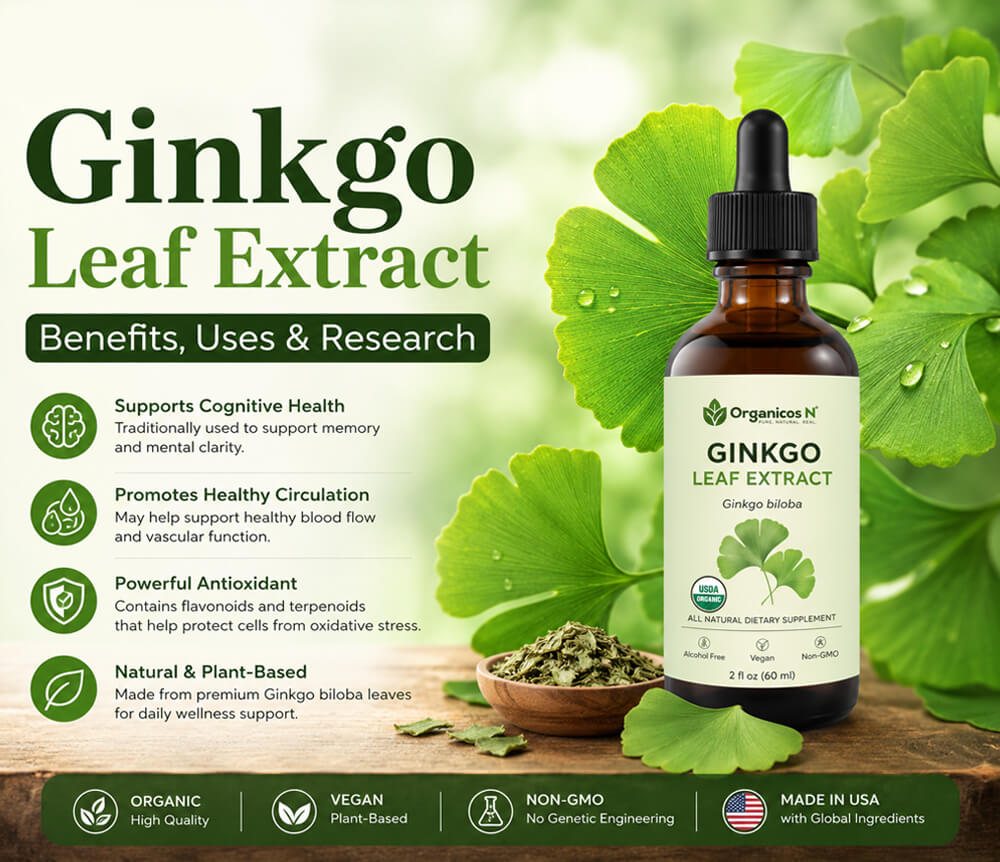
Ginkgo Leaf Extract: Benefits, Uses & What Research Says
Introduction
For centuries, plants have played an important role in traditional wellness practices around the world. One of the most recognizable botanical ingredients is Ginkgo biloba, an ancient tree often described as a “living fossil”. Today, ginkgo leaf is commonly prepared as an extract and is widely used as an ingredient in herbal and dietary supplement products. But what exactly is ginkgo leaf extract, why is it so popular, and what does modern research actually tell us about it?
Ginkgo leaf extract is made from the leaves of the Ginkgo biloba tree. It contains naturally occurring plant compounds that have attracted scientific interest, including flavonoids and terpene lactones. Ginkgo is often associated with discussions about cognitive health, circulation and antioxidant activity, although research does not support all of the health claims commonly made about the herb.
At Organicos N+, we believe that understanding botanical ingredients starts with knowing both their traditional background and what scientific evidence says today. In this guide, we explore ginkgo leaf extract, its potential uses, the research surrounding it and important considerations when choosing an herbal extract.
What Is Ginkgo Leaf Extract?
Ginkgo leaf extract is a concentrated botanical preparation derived from the leaves of Ginkgo biloba, a tree native to China that is now cultivated in many parts of the world.
The ginkgo tree has an exceptionally long history. According to the National Center for Complementary and Integrative Health (NCCIH), ginkgo is an ancient tree species and has traditionally been used in Chinese medicine for various purposes. Today, the leaf—usually in extract form—is the most commonly used part of the plant.
Unlike ginkgo seeds, which can be toxic when consumed in raw or roasted form, properly prepared ginkgo leaf extracts are the form generally used in dietary supplements.
What compounds are found in ginkgo?
Ginkgo leaves naturally contain several types of plant compounds. Among those that have received scientific attention are:
- Flavonoids
- Terpene lactones
- Other naturally occurring botanical compounds
The exact composition of an extract can vary depending on the plant material, extraction method and standardisation process. This is one reason it is useful to look beyond the name of an ingredient and consider the quality and specifications of the actual extract.
Why Is Ginkgo Leaf Extract Popular?
Ginkgo has become particularly well known because it is frequently marketed in connection with brain health and cognitive wellness.
It has also been studied for areas including circulation, anxiety, tinnitus, vertigo and age-related cognitive concerns. However, popularity should not be confused with proven effectiveness. NCCIH states that there is currently no conclusive evidence that ginkgo is helpful for any specific health condition.
This distinction is important when evaluating herbal ingredients. A responsible approach is to recognise what an herb has traditionally been used for while also considering the quality and limitations of modern scientific evidence.
Potential Benefits and Uses of Ginkgo Leaf Extract
1. Antioxidant Interest
Ginkgo leaves contain flavonoid compounds that have antioxidant properties in laboratory research. Antioxidants are compounds that can help neutralise certain reactive molecules known as free radicals.
Oxidative stress is an area of ongoing scientific research because it is associated with numerous biological processes. However, laboratory findings should not automatically be interpreted as proof that consuming a particular herbal extract will prevent or treat a disease.
For this reason, it is more accurate to describe the antioxidant activity of ginkgo as an area of scientific interest rather than making broad therapeutic claims.
2. Cognitive and Brain Health Research
Ginkgo is perhaps best known for its association with memory and cognitive health.
Researchers have investigated whether ginkgo supplementation can improve cognitive performance or reduce cognitive decline. The results, however, are mixed.
According to NCCIH, large studies have not shown ginkgo to be effective in preventing or slowing dementia. Research involving healthy adults has also not established that ginkgo reliably improves cognitive performance.
Some studies have reported modest effects in particular groups or circumstances, but the overall evidence remains inconsistent.
Therefore, ginkgo leaf extract should not be presented as a treatment for dementia, Alzheimer’s disease or other neurological conditions.
3. Research Into Circulation
Ginkgo has also attracted interest because of its possible effects on blood flow and vascular function.
This is one reason ginkgo products are sometimes marketed for circulation and related wellness purposes. However, research has not established ginkgo as an effective treatment for cardiovascular disease or high blood pressure. NCCIH specifically notes that research does not support ginkgo for preventing heart disease or treating high blood pressure.
For consumers, this highlights the importance of separating research interest from clinically established benefits.
4. Traditional Herbal Use
Another reason people choose ginkgo is its long history as a botanical ingredient.
Traditional use does not prove that an ingredient will provide a particular health outcome, but it provides valuable context for understanding why ginkgo has remained an important botanical for generations.
Modern herbal products bring together this traditional knowledge with contemporary extraction, manufacturing and quality-control practices.
What Does Scientific Research Say About Ginkgo?
One of the most important questions when considering any herbal extract is: Does the research support the claims?
In the case of ginkgo, the answer is nuanced.
Ginkgo has been investigated extensively, but NCCIH reports that there is no conclusive evidence that it is effective for any health condition. For dementia prevention, large clinical studies have not shown that ginkgo reduces the risk of dementia or Alzheimer’s disease.
Research into other areas has produced mixed results. Some studies have suggested possible benefits for specific symptoms or conditions, but the overall evidence is not strong enough to establish ginkgo as a treatment.
This does not make ginkgo uninteresting. In fact, its extensive research history makes it one of the better-known botanical extracts. It simply means consumers should approach claims about ginkgo with realistic expectations.
Why can research results differ?
There are several reasons herbal research can be difficult to interpret:
- Different studies may use different extracts.
- Extract concentrations and standardisation can vary.
- Participants may have different health conditions.
- Dosages and durations may differ.
- Some studies may have methodological limitations.
- Results from laboratory studies cannot always be translated directly to humans.
NCCIH also notes that dietary supplements available commercially can differ in important ways from the products used in scientific studies.
Ginkgo Leaf Extract vs. Ginkgo Seeds
It is important not to assume that every part of the ginkgo tree is suitable for consumption.
Ginkgo leaf extract is the commonly used form in modern herbal supplements. Ginkgo seeds, on the other hand, contain compounds that can be toxic when consumed, particularly when raw or improperly prepared.
For this reason, consumers should only use ginkgo products according to the manufacturer’s directions and should not substitute ginkgo seeds for a properly prepared leaf extract.
How to Choose a Quality Herbal Extract
When purchasing an herbal extract, the name of the herb is only one part of the equation. Consider the following factors.
1. Know the botanical ingredient
Look for the botanical name, such as Ginkgo biloba, rather than relying only on a common name.
2. Understand the extract
Find out whether the product is an extract of the leaf and whether relevant product specifications are provided.
3. Look for transparent product information
A reputable herbal product should provide clear information about the ingredient, suggested use, serving information and other relevant product details.
4. Consider manufacturing and quality practices
Quality control matters because botanical products can vary considerably. Good manufacturing and testing practices can help ensure consistency and product quality.
5. Avoid exaggerated health claims
Be cautious of products promising to cure diseases, reverse serious conditions or deliver guaranteed results. “Natural” does not automatically mean “risk-free” or “clinically proven”. NCCIH emphasises that natural products can have side effects and may interact with medicines.
How Is Ginkgo Leaf Extract Commonly Used?
Ginkgo leaf extract is commonly available as an ingredient in dietary supplements and herbal preparations.
The appropriate amount and method of use depend on the specific product, concentration and formulation. Therefore, consumers should follow the instructions provided with their particular product rather than assuming that every ginkgo extract should be taken in the same way.
If you are considering ginkgo as part of your wellness routine, particularly if you take medication or have an existing health condition, speaking with a qualified healthcare professional is a sensible step.
Ginkgo Leaf Extract Safety and Precautions
Although ginkgo leaf extract is generally well tolerated by many adults when taken orally in moderate amounts, it is not appropriate to assume that it is risk-free for everyone.
NCCIH reports that possible side effects include headache, dizziness and gastrointestinal symptoms. More importantly, ginkgo may increase the risk of bleeding in people taking anticoagulant medicines such as warfarin. It may also interact with other medicines.
Extra caution is appropriate if you:
- Take blood-thinning or anticoagulant medication.
- Take prescription or over-the-counter medicines.
- Have a bleeding disorder.
- Are preparing for surgery or a dental procedure.
- Are pregnant or breastfeeding.
- Have a medical condition and are considering starting a new herbal supplement.
Pregnancy and breastfeeding require particular caution because there is limited information about the safety of ginkgo during breastfeeding and potential concerns during pregnancy.
Always follow the product directions and consult a healthcare professional when you are unsure whether an herbal extract is appropriate for you.
Frequently Asked Questions About Ginkgo Leaf Extract
What is ginkgo leaf extract used for?
Ginkgo leaf extract is commonly used as a botanical ingredient in herbal and dietary supplements, particularly in products marketed around general wellness, cognitive health and circulation. However, scientific evidence does not conclusively establish ginkgo as an effective treatment for any specific health condition.
Is ginkgo leaf extract the same as ginkgo biloba extract?
The terms are often used interchangeably when referring to extracts made from Ginkgo biloba leaves. When purchasing a product, check the ingredient and product information to understand exactly which plant part is used.
Is ginkgo leaf extract safe?
Ginkgo leaf extracts are generally well tolerated by many adults when taken orally in moderate amounts. However, side effects and drug interactions can occur. Ginkgo may increase bleeding risk, particularly when combined with certain anticoagulant medicines.
Can ginkgo improve memory?
Ginkgo is widely marketed for memory and brain health, but current evidence does not conclusively demonstrate that it improves cognitive performance in healthy people or prevents cognitive decline.
What should I look for when buying an herbal extract?
Look for clear ingredient information, appropriate product directions, transparent labelling and evidence of consistent quality practices. Avoid products that make unrealistic promises or claim to cure serious diseases.
Where can I find ginkgo leaf extract?
Organicos N+ offers Ginkgo Leaf Extract as part of its range of organic, all-natural liquid herbal extracts. The wider herbal-extract range also includes botanicals such as Gotu Kola, Turmeric, Valerian, Green Tea, Chamomile, Garlic, Fenugreek, Asian Ginseng, Amla and Brahmi.
Final Thoughts
Ginkgo leaf extract has a fascinating history and remains one of the world’s most recognizable botanical extracts. Its long-standing traditional use, distinctive plant chemistry and extensive research history have made it a subject of continued scientific interest.
At the same time, it is important to approach ginkgo with an evidence-based perspective. While research has explored its potential role in areas such as cognitive health, circulation and other aspects of wellness, current evidence does not conclusively establish ginkgo as an effective treatment for a specific health condition.
For consumers interested in botanical ingredients, the best approach is to choose clearly labelled products, understand how an extract is prepared, follow the manufacturer’s directions and consider potential interactions with medicines.
Explore the Ginkgo Leaf Extract and other botanical products from Organicos N+ and discover a broader range of herbal extracts for your natural wellness routine.Important: This article is for educational purposes only and is not intended to diagnose, treat, cure or prevent any disease. Always consult a qualified healthcare professional before starting a new herbal supplement, particularly if you take medication, are pregnant or breastfeeding, or have an existing medical condition.